
Dynamic Pricing Worked. That's Exactly Why Everyone Is Angry.
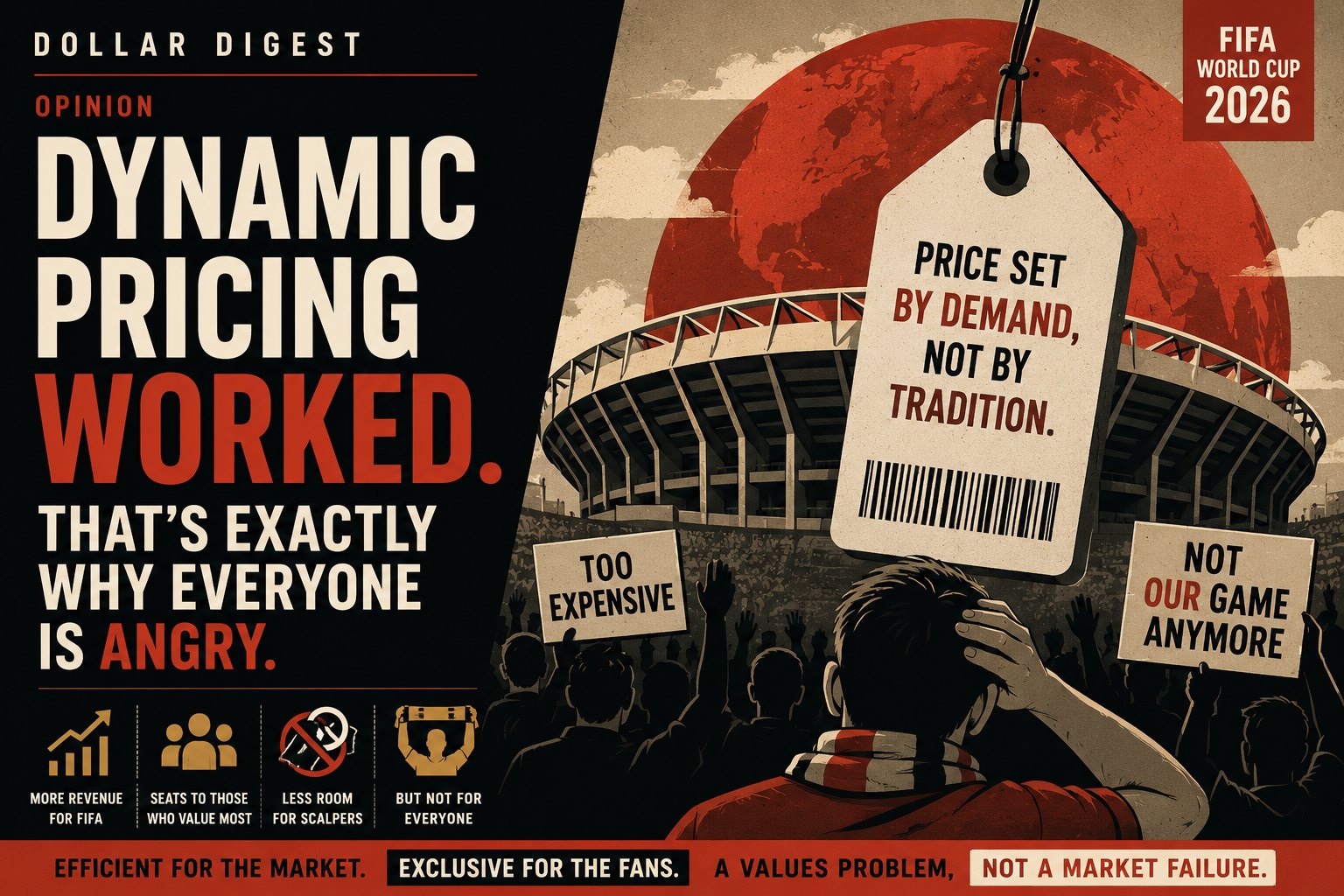
The 2026 World Cup sold out almost every seat in almost every stadium. FIFA called it a triumph. Fans called it a rip-off. Both of them are looking at the same number and reaching opposite conclusions, and the reason they can't agree is that they're actually arguing about two completely different things.
What happened at the 2026 World Cup is worth pulling apart carefully, because two separate complaints got bundled into one and the bundling is doing most of the work in the backlash.
The clearest evidence for dynamic pricing is also the one that got the least coverage. Argentina's group stage game against Algeria saw ticket prices fall 24% in the days before kickoff, as buyers started pricing in genuine uncertainty about how much of a Messi showcase they were actually going to get. That price movement is not evidence of a broken system. It is evidence of a functioning one. A price responding to new information in real time, adjusting downward when demand softened, is textbook market behaviour. Roughly half of all group stage fixtures saw prices fall in the three days before kickoff. Nobody wrote those headlines.
The efficiency rationale for dynamic pricing is a simple one and is worth laying out precisely before it is dismissed. There is a finite quantity of seats. Somebody needs to have them. A price that reflects actual demand is an effective means of distributing these seats to the people who value them most at the time of purchase. A flat price set months in advance doesn't actually solve the allocation problem. It just moves it. In a system of fixed prices, the seats go to whomever clicks fastest, whomever happens to have loyalty status, or whomever knows someone who can provide the tickets. Ultimately, the people who valued these seats the most still ended up paying scalpers twice or thrice the face value through the secondary market without any portion of this value going to FIFA, to the hosting cities, or even to anyone but the arbitrageurs in the middle.
The empty seats deserve a direct answer, because they are being used as proof of failure when they are actually proving something else. According to FIFA, the group stage witnessed 99.4% capacity utilization in tickets scanned. Empty blocks at Guadalajara for the match between South Korea and Czechia were spotted by broadcast cameras. All of the above is true. A seat that has been sold already is not an example of the market failure, but a transaction that has already taken place. The one, who deemed that the seat was worth the dynamic price, did make a choice. Whether he attended the match or not is a whole different issue from clearing the market with the right price. Confusion of those two moments, allocation and consumption decision, leads to the belief that the allocation has not been done.
So, if everything happens as it should, then why is everybody angry? Because the problem raised by critics is not about efficiency at all; it is about equity, although they have been stating the opposite.
Similarly, a ticketing process that distributes according to willingness to pay is, in the process itself, a ticketing process that distributes according to ability to pay. While this may seem more acceptable to the public in cases of tickets to Premier League matches or Taylor Swift concerts, there is a different kind of thinking about the World Cup altogether. The World Cup belongs to a community, to a nation, and even to a continent, rather than being perceived as a luxury product that has a clearing price. A researcher investigating this very issue was able to explain succinctly how a ticketing system can be sophisticated from a business perspective while still destroying the cultural identity of the event among those feeling excluded. That's not an objection based on economics but on values instead.
Here is the conclusion the column should probably end on, even though it's uncomfortable. Dynamic pricing at the 2026 World Cup is not broken. It is working exactly as designed. It raised more revenue, allocated seats to the highest bidders, and reduced the scalper's cut. And it made the experience worse for the fans who used to be the tournament's core audience, the ones who saved for years for a once-in-a-lifetime trip and found themselves priced into the upper deck or priced out entirely.
Both of those things are true at the same time. The discomfort isn't proof the market failed. It's proof that for something this emotionally loaded, a lot of people don't want the efficient outcome. They want a different and more communal one. Calling it price gouging is just a more comfortable way of saying that than admitting it's a values disagreement, not a market one.
More Opinion
Other Columns
Jul 6, 2026
We Read Freakonomics Wrong, and So Did Everyone Else
Freakonomics taught a generation that a clever enough economist could pull hidden truths out of any dataset. The book was not a fraud. The problem is subtler, and more interesting, because it is about what happens to an idea when you make it beautiful.

Jun 24, 2026
Chicago Did the Math. Everyone Else Threw a Party.
Sixteen cities looked at the same numbers and said yes. One looked at them and said no. Chicago walked away from the 2026 World Cup, and the economic record suggests it made the only intelligent decision in the entire tournament.
Jun 17, 2026
Margin Call Gets the Most Honest Line in Financial Cinema
Most financial crisis films are interested in the aftermath. The job losses, the foreclosures, the political fallout. Margin Call is interested in the eighteen hours before any of that happens, and that choice turns out to be far more revealing.
Jun 11, 2026
The Big Short Got the Villain Wrong
Most people come away from The Big Short with the same reading: Wall Street was greedy, regulators were asleep, and a handful of contrarians got rich by being the only ones willing to look at the data. That reading is not wrong. It is just not the film's most important argument.