
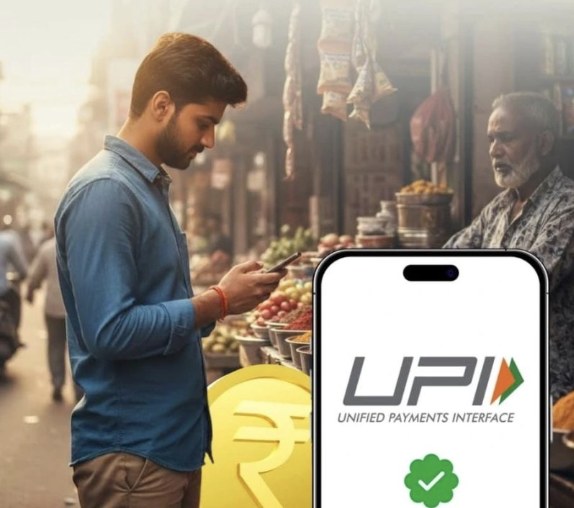
Walk past any vegetable cart or tea stall in urban India and you will see a QR code taped to the counter. It has become the visual proof of a story India tells about itself: that digital payments have pulled the informal economy into the light. Financial inclusion, formalization, transparency, the language is used almost interchangeably. It is also, on close inspection, not quite true.
UPI has done something real. It has not done the specific thing most people assume it has.
What actually changed
Since 2016, UPI has emerged as the dominant payment rail for small value transactions, with volumes dwarfing all other digital payment methods combined in India. A vendor that used to operate in cash only now can take a payment instantly, without a POS terminal, without a bank visit, without a merchant fee. That is a real change in operation, and it has tangible impacts. Research on UPI adoption by small enterprises has associated it with less dependence on informal moneylenders, increased visibility of cash flow and in some studies, an increase in GST filings by small and medium enterprises as digital footprints made it difficult to under-report revenue.
None of that is nothing. But look closely at what is actually being measured, and the claim narrows fast.
Digitization is not formalization
Formalization, in the way economists actually use the term, means a business exists inside a specific set of legal and administrative structures: it is registered, it pays applicable taxes, its employment shows up in official statistics, and it can access formal credit against a documented track record. Digitization means a transaction leaves an electronic trace.
These are two different axes, and UPI moves one of them without touching the other. A vegetable vendor has digitized her transaction by taking a QR code payment. She does not have a registered business. And she has not crossed the GST threshold, which for most goods is well above what a street-level vendor makes in a year, so she has no obligation to pay it. Since the Ministry of Statistics' employment data is not designed to detect a payment method, she shows up in it no differently than she did five years ago. She still cannot walk into a bank and get a working capital loan on the strength of her UPI history. That history is not considered bankable financial data by most lending institutions, whatever the digital public infrastructure narrative promises.
The vendor is more visible. She is not more formal.
Where the two get conflated
This slippage matters because it directs policy conversation in a particular and consequential way. When digitization is confused with formalisation, the problem as it appears is smaller than it is. Officials can point to the hundreds of millions of small merchants using UPI as proof that inclusion is happening, when the real markers of formal status, registration, tax compliance, social security coverage, labour protections, have hardly moved for the same population. When the metric being celebrated was never designed to capture the thing that was promised, it is easy to call partial progress full progress.
There is a genuine bridge here, and it deserves credit. A consistent digital transaction history is, in principle, exactly the kind of data that could eventually be used to build alternative credit scoring for people with no formal financial history, and pilot programs attempting this already exist. But a bridge that has not yet been built is not the same as arrival. The infrastructure for turning payment data into formal financial access exists mostly as potential, not policy.
The honest version of the story
UPI's real achievement is narrower and, frankly, more interesting than the version usually told. It solved a transaction problem at a genuinely enormous scale, and it generated a data trail that did not exist before, one that could eventually underpin real formalization if credit systems, tax thresholds, and registration processes are redesigned to use it. What it did not do, on its own, is convert India's informal workforce into a formal one. Those are different projects, running on different timelines, and only one of them is finished.
The QR code on the tea stall counter is real progress. It is also, still, just a code.