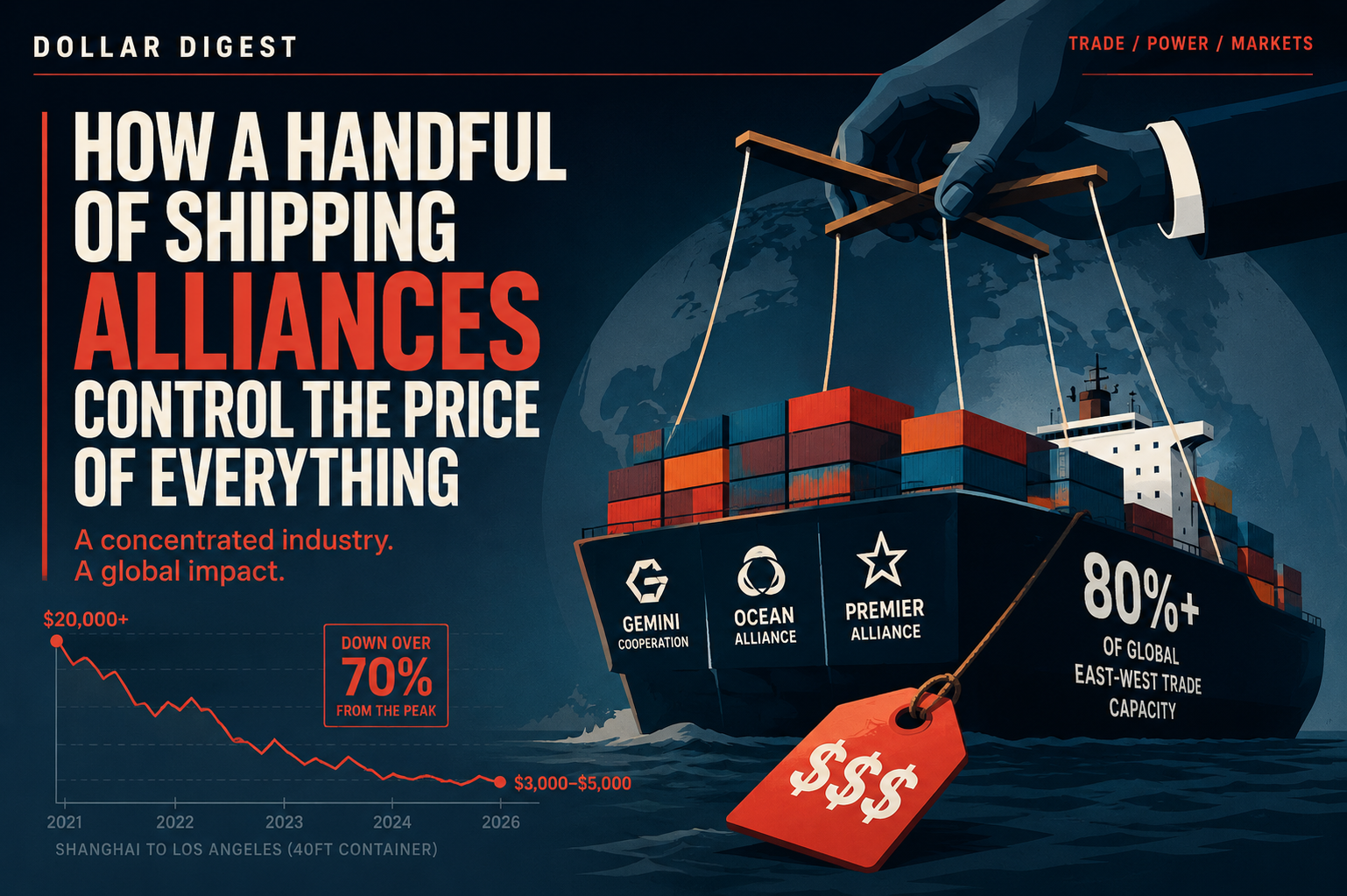
In early 2022, shipping a standard container from Shanghai to Los Angeles cost over $20,000. Today, that same journey is running somewhere between $3,000 and $5,000 depending on the week, down over 70% from the peak. That collapse did not happen because the world suddenly got better at moving goods. It happened because a handful of corporate alliances lost control of the supply side, and the market swung violently as a result.
Most people think of container shipping as a straightforward competitive market. Lots of ships, lots of routes, prices set by supply and demand. The reality is considerably stranger. Three alliances, the Gemini Cooperation, the Ocean Alliance, and the Premier Alliance, collectively control over 80% of global east-west trade capacity. MSC, the world's largest carrier by fleet size, operates independently but still commands roughly 20% of global capacity on its own. This is not a market with thousands of competing sellers. It is a market where a small number of coordinated players make decisions that determine what it costs to move nearly everything that crosses an ocean.
These alliances are legally permitted to coordinate vessel sharing, scheduling, and slot allocation across their fleets. What they cannot do, technically, is coordinate on pricing. But the distinction is thinner than it sounds. The primary tool carriers use to manage rates is something called a blank sailing, where a scheduled voyage is simply cancelled to remove capacity from the market and prevent rates from falling further. Earlier this year, carriers announced 66 blank sailings across major east-west trades in a single five-week stretch, a 9% cancellation rate. In March 2026, post-Lunar New Year blankings were up 38% from earlier projections. Research has shown the correlation clearly: on Asia-Europe, systematic capacity removal reversed seven weeks of rate declines, demonstrating carriers' ability to establish rate floors through disciplined supply management. That is not pricing coordination. But it produces the same outcome.
The parallel to OPEC is not a loose analogy. It is structural. OPEC manages oil prices by cutting production when the market is oversupplied. Shipping alliances manage freight rates by cancelling voyages when the market is oversupplied. The mechanism is functionally identical. The legal status is different only because antitrust exemptions that exist nowhere else in most industries have historically applied to shipping. The US Ocean Shipping Reform Act of 2022 was passed specifically because regulators decided that alliance behaviour during the pandemic rate spike had crossed a line, and that shippers had been treated unfairly.
Where the analogy breaks down is also the most interesting part. OPEC can cut production relatively quickly. Shipping capacity cannot be unwound on short notice because ships take years to build, and once an order is placed, that capacity is coming regardless of what the market looks like when it arrives. The global fleet expanded by roughly 28% in capacity between 2021 and 2026. Those orders were placed when 2022's record profits made expansion look rational. They arrived right as demand cooled and trade patterns shifted. Xeneta's chief analyst projected that 2026 would be a year defined by overcapacity, compounded by the potential return of services to the Red Sea. The cartel-like discipline works on the demand side through blank sailings. It completely fails on the supply side because nobody can un-order a ship.
As of the week of June 18, Drewry's World Container Index stood at $3,969 per 40-foot container, up 12% week on week, with Transpacific and Asia-North Europe rates both rising 13%. That spike is being driven partly by peak season demand and partly by carriers implementing surcharges ahead of expected US tariff changes in July. It is a reminder that this market oscillates fast. Rates were in freefall earlier this year. They are now climbing again, and carriers are once again reaching for the blank sailing lever to hold the line.
The lesson here is not that shipping is broken. It is that the infrastructure underneath global trade is far more concentrated, and far more managed, than the word "market" implies. The price of moving goods around the world is not set by competition between thousands of independent sellers. It is set, to a significant degree, by scheduling decisions made inside a small number of corporate alliances operating with legal exemptions that no other industry enjoys. When you buy something that was made in Asia and shipped to you, a meaningful portion of what you paid reflects those decisions. Most people have no idea that layer exists.