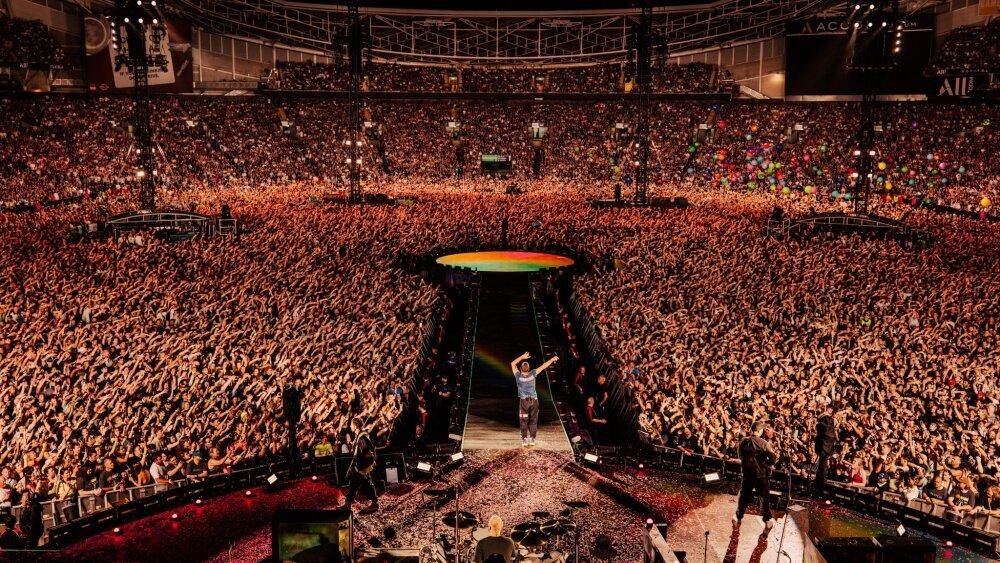
When Coldplay played Ahmedabad's Narendra Modi Stadium in January 2025, the city reorganised itself around two nights of music. Metro ridership spiked by 405,000 passengers. Hotels charged Rs 15 lakh per night. Ticket sales alone generated Rs 322 crore. The total economic impact on Ahmedabad, as calculated by BookMyShow and EY, came to Rs 641 crore.
That gap between Rs 322 crore and Rs 641 crore is the entire story of how music festivals actually make money. And it is not the story most people tell about India's live events boom.
The Cost Structure Nobody Talks About
India's organised live events sector crossed Rs 12,000 crore in 2024. Over 30,000 ticketed events took place across 319 cities, an 18% increase from the previous year. Every piece of industry coverage frames this as a straightforward success. Revenue up. Attendance up. New cities, new formats, new audiences. The EY-Parthenon and BookMyShow report projects the market to reach Rs 143 billion by 2026. Lollapalooza India has brought in Green Day, Linkin Park, and Louis Tomlinson. Rolling Loud made its India debut in 2025 with Central Cee, Karan Aujla, and Don Toliver. By any measure, the market has arrived.
What this framing skips entirely is the cost side.
International headliner fees for India shows have risen sharply as promoters compete to establish India as a credible stop on the global touring circuit. Industry estimates range from $500,000 to $2 million per show for the biggest international acts, excluding production costs, freight for equipment, technical crew and visa logistics, but exact numbers are not public. Even for a two day festival with a credible international line-up, talent alone routinely eats up 50-70% of total ticket revenue before a single rupee has gone to venue rental, marketing, security or ground infrastructure.
The math is not cooperating. If NH7 Weekender manages to sell 20,000 tickets at an average price of Rs 3,000, the gate revenue will be Rs 6 crore. A Rs 5 crore international act in the middle tier would cost $600,000 at present exchange rates. The festival has not paid for a second act, a stage, a sound system, staffing, food vendors or the permit fees that local authorities routinely impose on large gatherings. The sale of tickets is not a business per se. It’s a customer acquisition cost.
The Closed Economy
The mechanism that makes festivals financially viable is not the gate. It is what happens once you are inside.
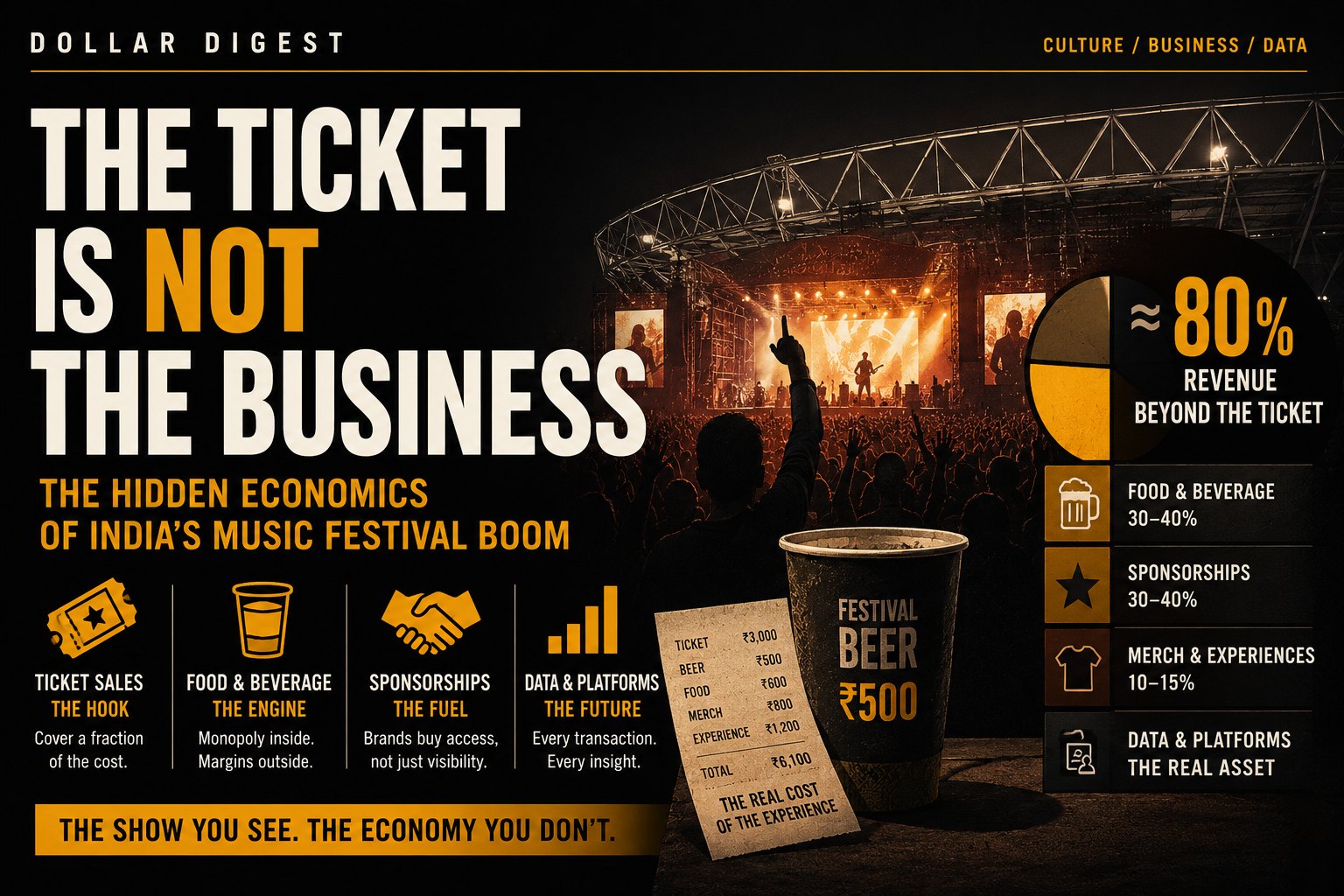
Festival grounds in India operate as self-contained commercial environments. Outside food and beverages are prohibited at virtually every major event, including Lollapalooza India, NH7 Weekender, and Sunburn. The only place to spend money inside the perimeter is with vendors who have paid for the right to be there, and on alcohol that the organiser or their brand partner controls. A beer inside a festival costs Rs 400 to 600. The same beer retails for Rs 80 to 100. The margin is not incidental but highly intentional.
Multiply that across 60,000 attendees over two days and food and beverage revenue becomes the single largest contributor to festival profitability. And it’s not only India. In the US, Coachella makes more from on-site spending, merch and brand activations than it does from ticket sales. Glastonbury in the UK has been running its own bar network for decades, generating revenues that subsidise the music programme. What India has done is to take that model and apply it to a market with dramatically lower tolerance for ticket price, but rapidly rising willingness to spend on experience once inside the venue.
The Sponsorship Architecture
The second revenue stream is structurally different from traditional advertising and significantly more valuable.
Bacardi has title-sponsored NH7 Weekender for years. Kingfisher owns Sunburn in any meaningful commercial sense. Mahindra's name is on the blues festival in Mumbai. These are not banner placement deals. They are integrated commercial arrangements where the brand becomes part of the event's identity, its stage naming, its on-ground activations, its merchandise, its social content, and its data capture. A brand buying a festival sponsorship is not buying visibility in the way it buys a billboard on a highway. It is buying access to a captive, demographically specific, emotionally engaged audience for six to twelve hours without any competing commercial messages.
Industry estimates place sponsorship at 30 to 40% of total event revenue at major Indian festivals. For a property like NH7 Weekender, which runs across multiple cities and formats, the sponsor relationship effectively funds the touring costs that ticket revenue cannot cover. Bacardi's investment is not charity. It secures the only bar on the premises.
Why Infrastructure Scarcity Is a Feature, Not a Bug
India has almost no purpose-built festival infrastructure. There is no Indian equivalent of Hyde Park or Madison Square Garden that is routinely available for large outdoor events. Promoters work with racecourses, cricket stadiums, exhibition grounds, and open fields, importing sound systems, stages, barriers, generator sets, and toilet blocks for each event.
This looks like a constraint, and in many ways it is. In 2024, NH7 Weekender Pune was called off mere hours before the gates were to open due to law-and-order issues, a natural fall-out of operating on borrowed infrastructure with a complex web of permit dependencies. Sound curfews, police permissions and municipal approvals create an uncertainty that hangs over the final days of production. Backstage infrastructure had finally reached international standards, even at Lollapalooza 2026, artists and crew quoted in the Forbes India piece on India’s concert economy noted, implying this had not always been the case.
But the absence of permanent venues has an economic upside that rarely gets named. When a festival takes over a makeshift ground, it brings everything with it. There is no external restaurant on the edge of the venue doing Rs 50 lakh in business that weekend. There is no competing bar two minutes away. The organiser imports the entire on-site economy and captures every rupee spent within it. The infrastructure gap that the industry lobbies against is also the source of the margin structure that makes the industry work.
The Platform Consolidation Bet
In August 2024, Zomato acquired Paytm Insider for Rs 2,048 crore. Paytm Insider was generating roughly Rs 275 to 300 crore in annual revenue at the time. The implied multiple of nearly 7x made no sense as a ticketing business acquisition. It made complete sense as a data acquisition.
The bet Zomato was making is that the person ordering dinner on a Friday night and the person buying a concert ticket for Saturday are the same person, and that owning both transactions gives you a picture of discretionary consumer behaviour that neither a food delivery platform nor a ticketing platform has on its own. Zomato subsequently launched District, an app bundling restaurants, movies, concerts, and sports events. The logic is behavioural, not operational. You do not buy Paytm Insider because you want to sell more tickets. You buy it because knowing what someone does on a Saturday night is worth more than the commission on a Rs 3,000 ticket.
BookMyShow has responded by moving up the value chain, investing in permanent venue infrastructure and partnering with government bodies to develop dedicated concert halls in Mumbai. The platform that controls the physical space controls pricing, access, and data simultaneously. This is the same dynamic that played out in the United States when Live Nation acquired Ticketmaster, producing a vertically integrated entertainment company that regulators spent fifteen years attempting to unwind. India is approximately ten years behind that consolidation curve.
What This Does to the Artists
The economics of the closed on-site model are not neutral for who performs.
A festival's surplus revenue is split mainly between the festival organiser, the alcohol brand and the ticketing platform. The headliner takes a big upfront fee, but no share of beverage revenue, no cut of sponsorship and no percentage of on-site retail. The structural logic that makes international acts expensive to book also limits the amount of commercial upside that comes back to them, as their leverage is tied to the guarantee negotiated ahead of the event, not the economic activity their draw produces inside the venue.
For independent Indian artists, the situation is sharper. NH7 Weekender built its identity over a decade on platforming independent Indian acts, Prateek Kuhad, The Local Train, Parekh and Singh, Nucleya, artists who drew audiences that were loyal but not large enough to anchor the cost structures of a multi-day festival. As headliner fees have risen and the economics of the multi-day format have become harder to sustain on that audience size, NH7 has shifted toward a one-day touring format in smaller cities. The commercial logic is clear. The cultural loss is not nothing either.
India's live events market is growing at 17% annually. The sectors capturing that growth, namely organisers, alcohol brands, and platform companies, are not the same sectors that built the cultural infrastructure making that growth possible.
The Mechanism
The simplest version of how this works: festivals charge for entry to recover a fraction of costs, sell alcohol at monopoly margins to cover the rest, charge brands for the right to be present in a controlled emotional environment, and capture data on every transaction for the next time. The headline act is expensive. The beer is more expensive. And the information generated by both is the most valuable thing produced by the entire weekend.
India's music festival boom is real. The economics of it are just not where anyone is looking.