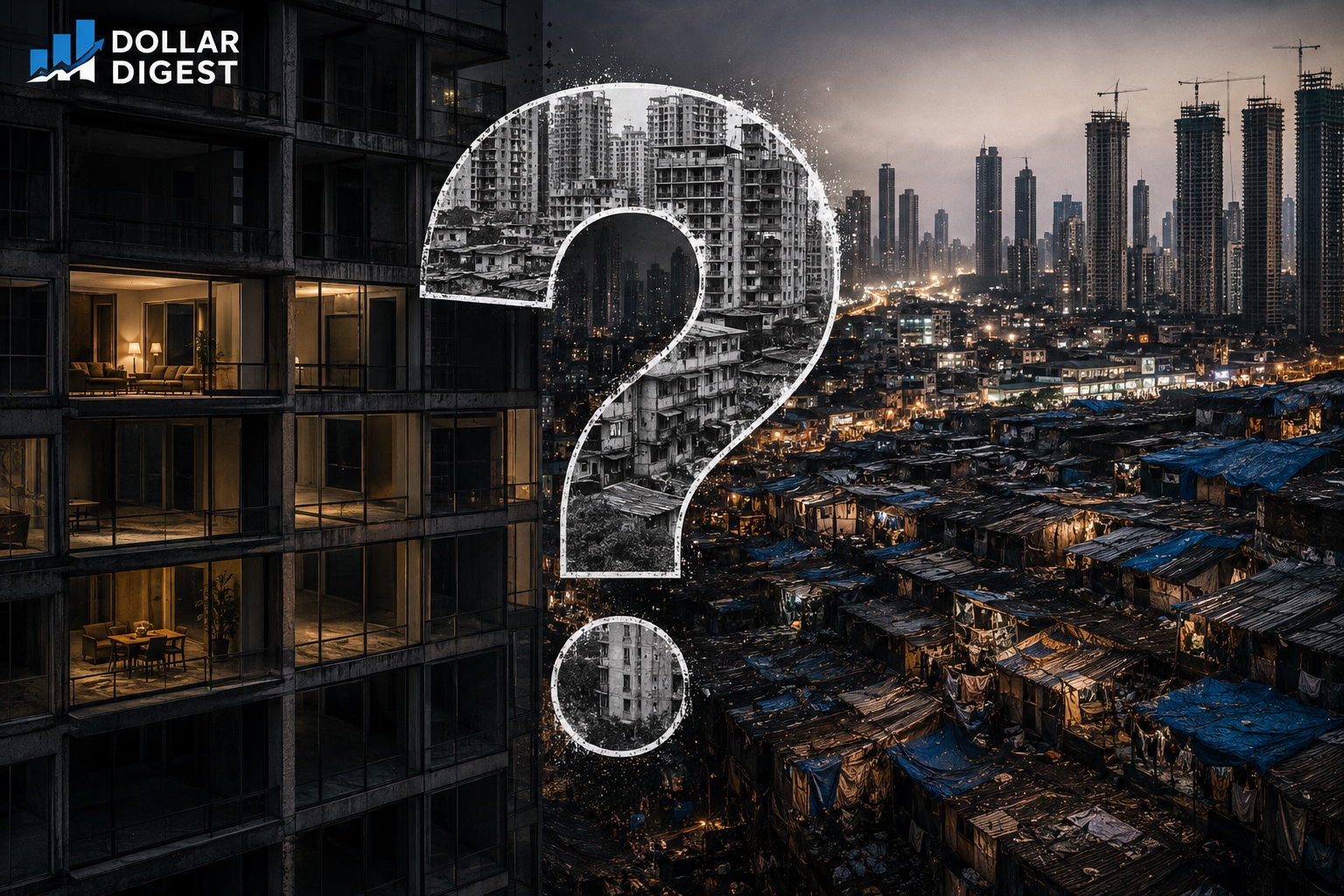
When you walk through parts of Mumbai, you will see two things that should not exist together. Families are stacked three generations deep into one room because they cannot afford anything bigger. A few kilometres away, entire towers stand finished and empty, waiting for buyers who are not coming. Thousands of flats across the city sit unsold for years. Not because nobody needs a home. Because the people who need homes cannot afford the flats that are sitting empty, and the people who built those flats will not lower the price to meet them.
This makes no sense. You would assume that a developer who has put in crores of rupees to build a tower will want to sell it as fast as he can, even at a lower price, rather than let it sit there and earn nothing. But developers often do the opposite. To understand why, you have to stop thinking of a flat as a place to live and start thinking of it as an asset, because that's what the seller thinks of it.
The store of value problem
Most goods depreciate, or lose their value, the longer they sit unsold. Every season a shirt doesn't sell, it's discounted. But it doesn't work like that in a flat, or at least the developers don't think so. In a city like Mumbai real estate is a store of value, something that maintains or increases in value over time, whether populated or not. This is because Mumbai is a waterlocked city so it can't expand as its population grows, like Delhi did.
In the seller's mind, an empty flat is still an appreciating asset, and they expect it to grow in value over time. That changes the whole incentive. If you think your flat will be worth more in 2 years than it is today then it isn't smart business to sell it cheap now to clear inventory, it is giving away future value for no reason. Instead of reducing the price, developers wait. They would rather keep a flat empty for three years and sell it at the number they wanted, than sell ten flats today at a discount.
Loss aversion makes waiting feel safer than it is
There's a second part to this and it's more about psychology than spreadsheets. Once a developer has priced a flat at a specific figure, to reduce that price does not feel like a small business adjustment. It is a loss. Among behavioral economists, this is known as loss aversion, described as the tendency to feel the pain of losing something about twice as strongly as the pleasure of gaining an equivalent amount. When a developer puts up a flat for sale at two crore, and sells it for one crore eighty lakh, they do not feel like they have earned that 1.8 cr. They feel they have lost twenty lakh rupees, even though they did not have that money in hand in the first place.
That is why prices in Indian real estate are resilient to downfalls. Developers will let inventory pile up for years rather than take a visible cut. A discount is public. Every other buyer, every other broker, every other developer in the area sees it, and it resets what the market thinks the building is worth, not just for that one flat but for every unit in the tower. So the loss is not just the discount on one sale. It is the perceived loss in value across everything else they are still holding.
A consumption good trapped inside an asset market
Put these two things together and the picture becomes clear. A flat is, in theory, a consumption good, something built to be lived in, like food or clothing. But it is being priced and held like an investment asset, something meant to appreciate while sitting untouched. Those two logics do not match. A city with an actual housing shortage needs prices to fall until ordinary buyers can afford them. A market built around asset appreciation needs prices to hold or rise, no matter how long that takes or how many units sit dark.
Nobody is lying about the shortage, and nobody is lying about the empty towers. Both are true, at the same time, in the same city, because Mumbai's housing market is not really one market. It is a consumption market wearing an asset market's clothes, and the person deciding the price is never the person who needs the home.